.png)
July 14, 2026
Building Public Trust: A Conversation with CCF Distinguished Fellow Afua Bruce
CCF Insights

This past February, Cherokee Nation and Center for Civic Futures partnered to host the first-ever Tribal Innovation Summit, an event on the belief that tribal nations shouldn't just adopt the technology of tomorrow, but help define it.
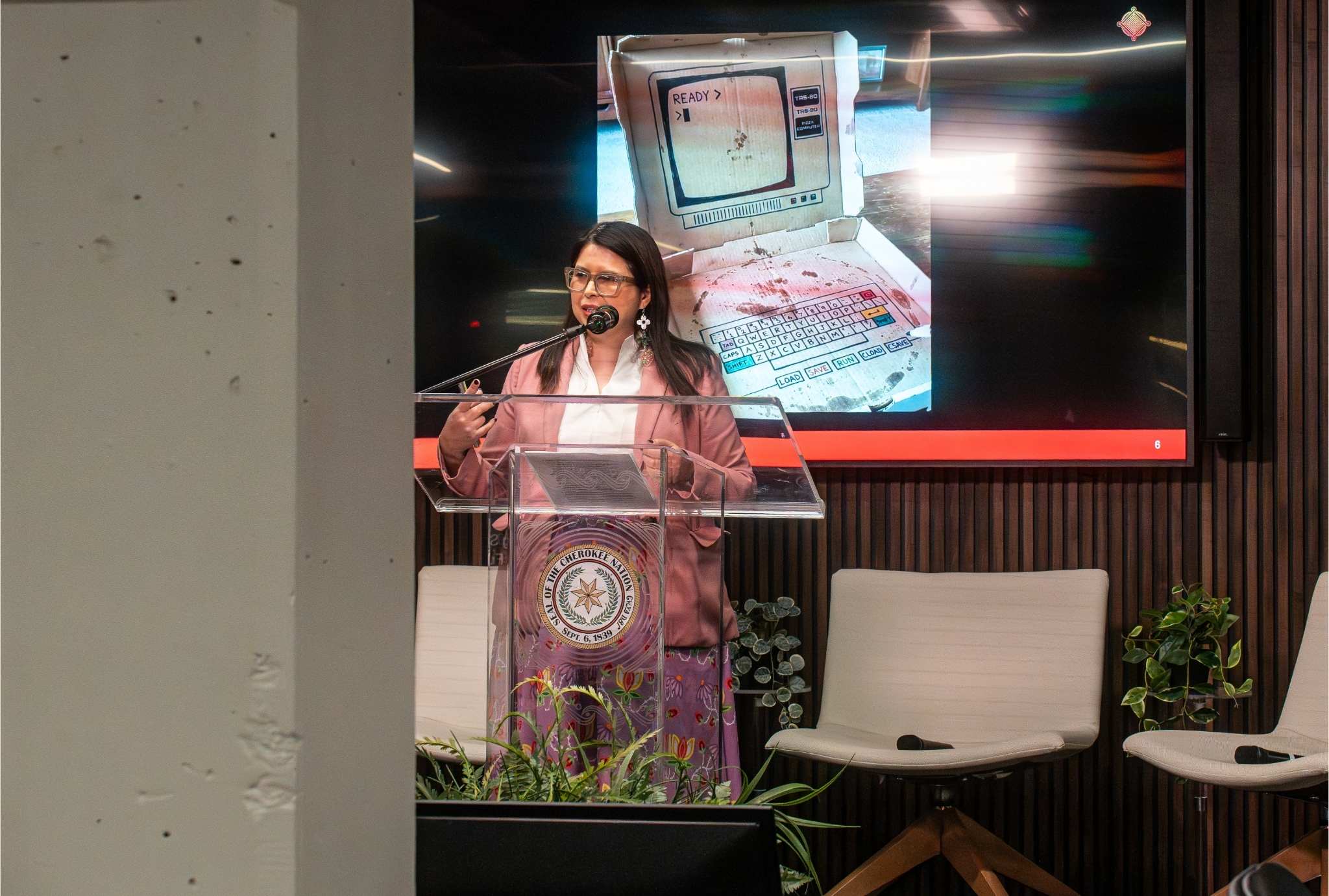
In a moment that felt electric with possibility, I reflected back on my first computer, a Radio Shack TRS-80 drawn on a Mazzio’s pizza box.
While chain restaurants did not exist in my small Oklahoma town, a Mazzio’s pizza truck would occasionally roll into town. On one special evening my uncle drove into town and brought back one of those pizzas to my granny's house. After we ate every slice, I picked up that greasy cardboard box and created my first computer.
I played with that imaginary computer for a long time.
What's remarkable isn't that I knew what a computer looked like. What's remarkable is why I knew. Inexplicably our small school had a computer lab filled with TRS-80s. Two teachers, Mary Alice Fletcher and Mary Roberts, introduced us to computing. They didn't put kids in front of those machines to play games. They expected us, a group of children who had never touched a computer before, to boot them up and code. We wrote BASIC. We created things. We lived up to the expectations they set for us.
The Seeds We Can't See Growing
Mary Alice Fletcher and Mary Roberts could not have known what they were doing in the fullest sense. They couldn't have predicted that one of those kids would go on to become the Chief Information Officer of the Cherokee Nation a role that would prove pivotal during a post-COVID digitization era when governments across the country needed to rapidly modernize to serve their citizens. They couldn't have mapped that trajectory from playing with a pizza box to leading technology service delivery at the nation’s largest tribe. No one could have.
But they planted the seeds anyway.
That's the lesson I carried into the Tribal Innovation Summit. We are not here because we can predict the future. We're here because we understand that the future is built in the present by the investments we make, the expectations we set, and the people we believe in before they believe in themselves.
What This Means for Tribal AI
The Tribal Innovation Summit brought together technologists, Tribal leaders, and civic innovators who are asking hard questions about how artificial intelligence can serve and be governed by Tribal nations on their own terms. What emerged from our convening wasn't a single answer, but something more valuable: a community of practice committed to sovereignty, self-determination, and the long view.
The work ahead goes beyond being technical. It is generational. Somewhere right now, there is a kid in a small community who has never seen what their future could look like. Our job is to be Mary Alice Fletcher and Mary Roberts.
We may not live to see what grows. But we can plant the seeds.
What Tribal Governments Need to Thrive in the AI Era
.jpg)
What became clear at the Summit is that this moment demands more than awareness. It demands investment in people, in tools, and in each other.
First, we need our own people in the rooms where these systems are being built. Indigenous technologists are still underrepresented in the roles that shape how AI develops. And yet, at the Summit, I heard our Indigenous youth panelists say plainly that they want to come home — that they want to bring their skills back to their communities and help shape the decisions that will affect their futures. That desire is a resource. We have to meet it.
Second, we need technology that actually reflects us. AI systems today are optimized for scale and dominant languages and cultures. Indigenous knowledge, history, and ways of knowing are too often absent or distorted. That isn't inevitable. It's a choice that was made, and it's a choice that can be unmade. The work already being done to build AI tools grounded in Indigenous knowledge shows us what's possible when our communities lead the build, not just the adoption.
Third, and maybe most importantly, we need each other. One of the things that struck me most at the Summit was how many tribal leaders were navigating the exact same questions, in isolation, without knowing others were doing the same. Questions about data governance, about procurement, about how to build internal capacity when resources are thin. We've been solving the same problems alone for too long. The path forward is collective, and we're just beginning to build that infrastructure together.
Our Unimaginable Future
That little girl with the pizza box computer could not have dreamed of this moment: Tribal nations stepping forward to start defining how emerging technology will serve and reflect their communities. That future was unimaginable to her. To her whole generation.
And yet, as futurist Stewart Brand so aptly put it, "This present moment used to be the unimaginable future." The truth is we are all living in someone else's unimaginable future. And right now, we are planting seeds for futures that none of us can fully picture. That's not uncertainty — that's the work. The seeds are in the ground. Now we have to tend them.
---
If you are a Tribal government leader navigating these questions, or someone who wants to support this work, we'd love to hear from you. This conversation is just beginning and it belongs to all of us. Send an email to info@centerforcivicfutures.org to start the discussion.

.png)
.avif)